

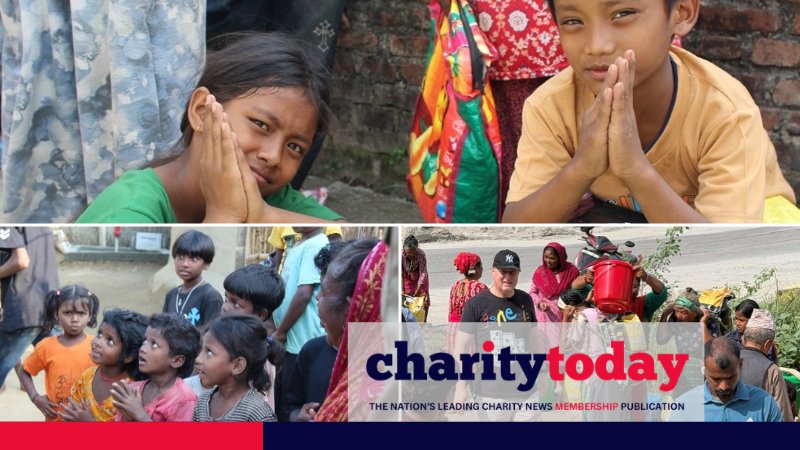

Nepal floods: The families left with nothing
Canon Gavin Kibble MBE, Chief Executive Officer of Coventry-based international humanitarian charity Feed The Hungry UK, reflects on his recent ten-day visit to Nepal, where he witnessed the devastating impact of flooding and joined local partners delivering emergency aid to families who have lost everything.
I was standing beside a lorry packed with food, helping distribute 25-kilogram bags of rice and buckets of essential supplies to around 150 people, most of them women, when I met Bikash.
With tears welling in his eyes, he told me something I will never forget.
“I lost six members of my family in the flood. We never found their bodies. How am I supposed to live with this? How do I say goodbye when I don’t know where my family are?”
There are moments when any words of sympathy seem hollow against the scale of such loss. This was one of them.
Watching the disaster unfold on the news on 26 August gave no real sense of its scale. The extent of the human tragedy can only truly be understood by seeing it first-hand and talking to the people whose lives have been touched by death and destruction.
The floods swept through a Himalayan valley with terrifying force, destroying entire settlements, roads, bridges, buildings and communication lines. Thousands of lives have been lost or changed forever, and many remote communities remain cut off.
I spent ten days in Nepal supporting Pastor Ruben Rasaili, who leads the Great Mission Nepal team on the ground, helping coordinate Feed The Hungry’s emergency relief efforts and the distribution of food to families in desperate need.
Villages that have disappeared
One of the most difficult places we visited was beside the Trishuli River, around 50 miles northwest of Kathmandu.
Standing on the riverbank, Ruben explained that the enormous stretch of mud and debris before us had once been a thriving village.
It was almost impossible to imagine.
Most of the 150 families receiving food that day had lost everything. Their homes, possessions and livelihoods had been swept away.
Behind us stood a pink house, buried in mud up to its first floor but otherwise largely intact. It was a haunting reminder of the community that had once existed there.
Everywhere we travelled, there were reminders of the flood’s extraordinary force.
In another town, we came across the rear axle and wheels of a large lorry lying abandoned in what was now an eerily quiet town centre.
This had once been a busy place, full of people going about their daily lives.
Now, the silence was overwhelming.
The people behind the devastation
Distributing emergency food is essential, but the challenges facing these families go far beyond providing basic supplies.
Giving out food is one thing. Getting it home is quite another, particularly when someone is elderly, alone or living in a remote part of the valley.
One woman we met was 85 years old. She lived two kilometres from our distribution point, up the side of the river valley.
She had lost both her granddaughters in the flood and was now living alone.
Stefan, a member of our team from the United States, and our van driver helped take her and her food supplies home.
It was a small act of kindness in the face of unimaginable grief, but one that mattered enormously.
Encounters like these stay with you.
Behind every statistic is a person, a family and a life that has been changed forever.
Reaching communities still waiting for help
Our partners have been working tirelessly to reach those affected.
Ruben has been sending a lorry-load of food every day, supporting around 2,500 families across the area.
But even two months after the disaster, many villages further upstream remain beyond our reach.
The destruction of roads and bridges has made transporting food, drinking water and other essential supplies extremely difficult.
Working with local suppliers, Ruben and his team have developed a plan to deliver rice, lentils, sugar, cooking oil and clean drinking water to affected families.
They are also working to provide emergency tents for 50 families who have nowhere safe to shelter, alongside transport to reach isolated communities.
Feed The Hungry UK has contributed $5,000 towards the response, as part of a wider international effort involving our teams in the United States and Australia, which have already provided a further $60,000.
The coordination between our international teams and local partners is helping us reach people who might otherwise be left without support.
But the need remains enormous.
The long road to recovery
The immediate priority is ensuring families have enough food, clean water and somewhere safe to sleep.
Yet we also recognise that recovery will take far longer than the initial emergency response.
Homes will need rebuilding, communities will need reconnecting, and people who have experienced terrible loss will need ongoing support.
For families like Bikash’s, the emotional scars may never fully heal.
I returned from Nepal deeply moved by the courage of the people I met and the determination of our local partners, who continue their work despite the enormous challenges.
The experience has reinforced something I have always believed. Humanitarian aid is not simply about delivering supplies. It is about standing alongside people when their world has been turned upside down and showing them that they have not been forgotten.
Lives destroyed in a moment will take many years to rebuild.
Feed The Hungry will be there, supporting our partners on the ground, to make sure the people of this remote part of the Himalayas are not forgotten.
How you can help
Feed The Hungry UK is appealing for public support to help families affected by the flooding.
A donation of £10 could provide a family with rice for a week, while £20 could supply lentils, sugar and cooking oil.
A gift of £35 could provide a family with a complete emergency food and clean water package, while £65 could fund an emergency tent for a family who has lost their home.
Every contribution, however small, can help our partners continue delivering vital assistance to people facing an uncertain future.
To support the emergency appeal, visit https://fth.org.uk/nepalflood.


